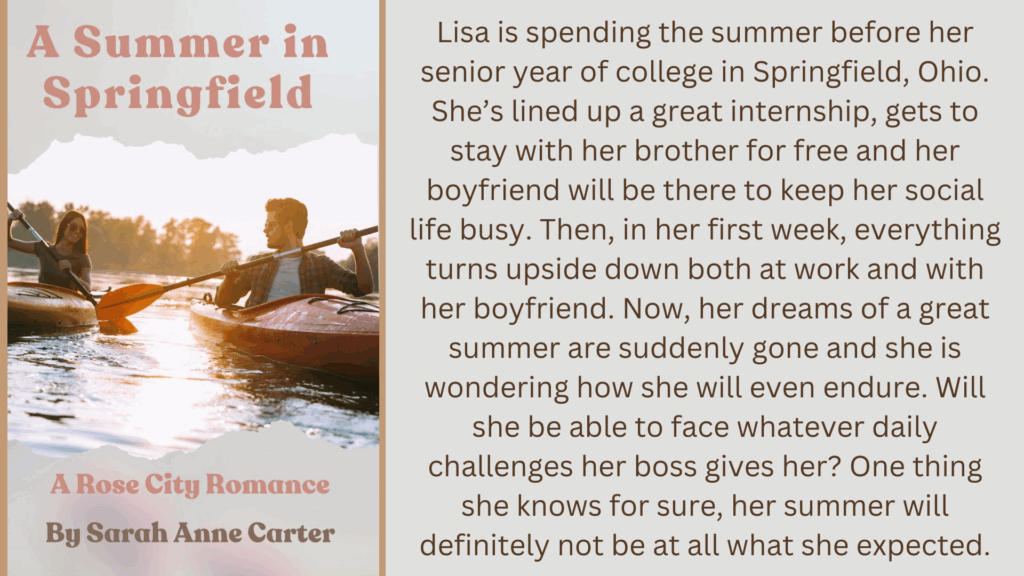
A Summer in Springfield is set in Springfield, Ohio. Some business names were kept and some were changed. If you live in the area, you will probably know the locations I’m referring to in the story. Springfield has a handful of nicknames, but one of its oldest ones is “Rose City.”
According to the historical marker located by the city’s rose statue:
For nearly 80 years Clark County was home to a flourishing nursery and florist industry. In fact, Springfield and Clark County grew and shipped more roses than any other city in the country. Rose growing and shipping became a multi-million dollar industry beginning in the 1870s with the innovation of a safe shipping process for young bushes and the availability of rail transportation.
In the late 1870s, Charles A. Reeser had an idea. He believed it was possible to send dormant one or two-year-old roses short distances by railroad. His former employee developed the process. Reeser opened a greenhouse and mail-order business, and the rest is history. In a 1919 publication, the Springfield Chamber of Commerce noted that there were 33 greenhouses in Springfield alone, which produced 9,637,000 roses each year. That total was even higher if you counted all the greenhouses in Clark County. In the 1930s more coal was used for the local floral industry than in the steel industry.
Even the most prosperous of local industries will inevitably meet stiff competition. The advent of the airplane, the availability of cheaper labor abroad coupled with rising demands for higher wages locally, and competition from growers using newer labor-saving devices combined to bring about the demise of the local rose industry. The majority of local commercial greenhouses were torn down in the early 1950s.
If you’re happening to be traveling through Ohio, you can stop off of I-70 and visit Springfield, Ohio. It’s nicknamed Champion City, along with Rose City. The crow is its token bird mascot. There’s a Frank Lloyd Wright house, along with theaters that were once sought after stops for Vaudeville acts. You’ll find a Coffin Station Road on the railway line and then find out most embalming fluid is made there. Now torn down, the city featured magazine publishing at the Cromwell Building before moving to New York City.
I’ve made it my home for a decade now and have loved seeing it come alive. You’ll find a vibrant downtown and a community that loves coming together.
To read about all the places in and around Springfield that inspired scenes in the book, check out my blog post: A Summer in Springfield Inspirations.
Buy A Summer in Springfield here (affiliate link). Available in paperback and Kindle versions.